Data Collection for groups and sites
The Data Collection tab allows you to control what information is collected by the Create Wizard in the EasyLife 365 Collaboration App when users initiate the creation of a new Microsoft 365 Group or SharePoint site.
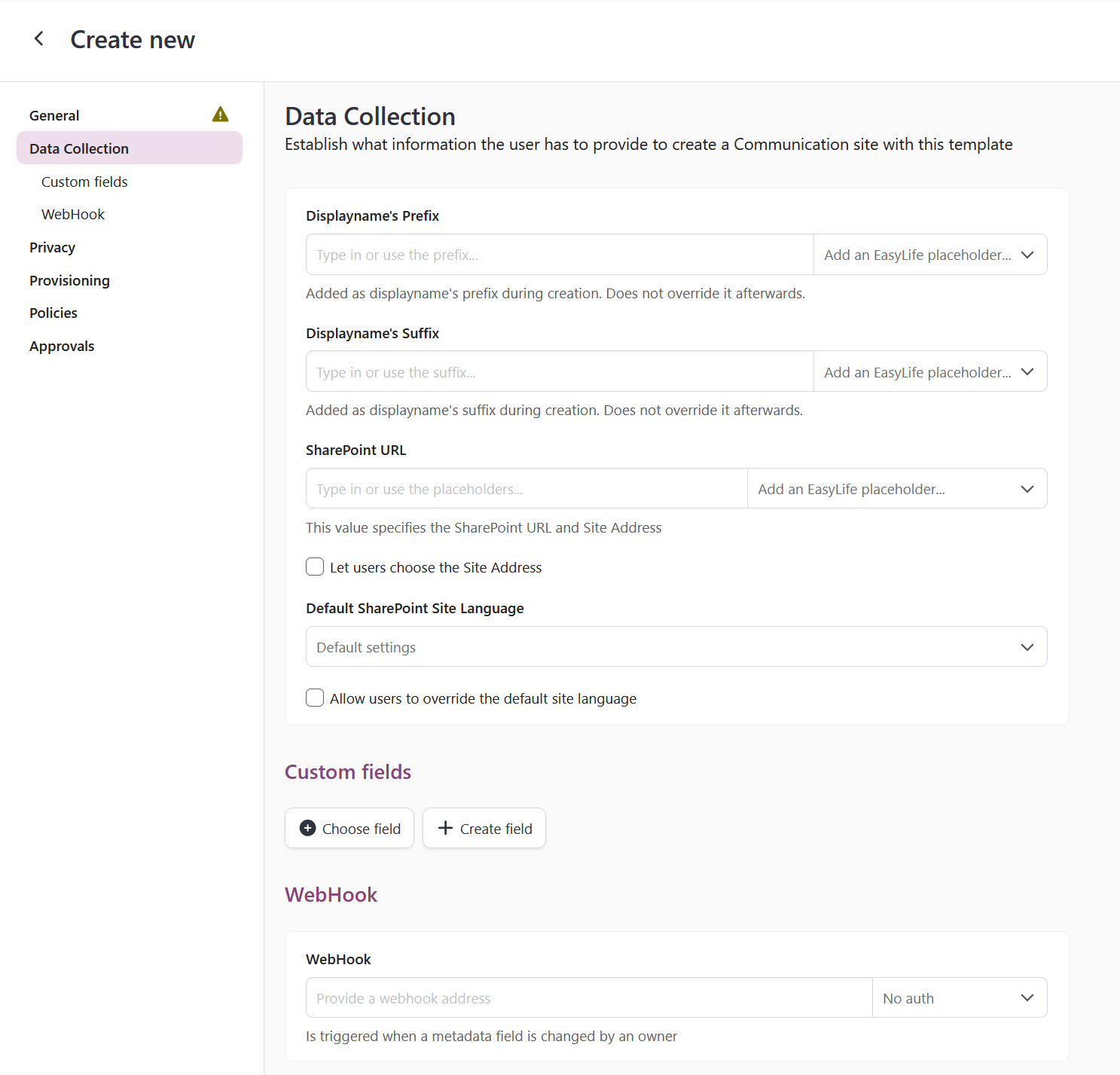
Naming Customization
Use the fields under Displayname prefix and Displayname suffix to define static prefixes and suffixes applied to the display name of the group or site.
This setting does not affect the mail nickname (alias) or the SharePoint URL.
To allow users to manually define a mail nickname for a Microsoft 365 Group, enable the Let users choose the mail nickname option.
This should be used only for exceptional scenarios. A naming convention or the default logic is strongly recommended.
Language and regional settings
You can define:
- A default SharePoint site language, or
- Allow users to choose the language in the Create Wizard.
The selected language will be applied during provisioning.
Regional settings such as time zone and locale should be configured using automation steps.
SharePoint site address
Enable the Let users choose the Site Address option to allow users to define the URL path of the SharePoint site. This enhances user autonomy and flexibility during site creation.
Description
By default the description of a group, Team or site is optional. Turn on Require a description to make it mandatory for everything created from the template. The switch is off by default. It is available on every template that creates a group (Microsoft 365 Groups, Teams, Viva Engage communities and Education) and on templates for SharePoint sites.

On a SharePoint site template the switch sits below Let users choose the Site Address.

When the switch is on:
- The Description field of the Create Wizard is required, and Next stays disabled until it holds text.
- Owners cannot save an empty description for a group, Team or site that uses the template. The same applies when an owner applies the template to an existing resource.
- EasyLife 365 checks the rule again when it receives the request, so it also holds for requests that do not come from the app.
A description counts when it contains at least one character that a reader can see. Spaces, line breaks and invisible characters do not count.
When an owner changes a resource to another template, the rule of the new template applies. A change that does not send a description leaves the existing description as it is. Changes that an administrator makes in the EasyLife 365 Admin are not checked against this rule.
Existing templates keep the switch off, so nothing changes for them until you turn it on.
Metadata Fields
The Fields section lets you define and bind metadata fields to the group or site. EasyLife 365 supports multiple input types:
- Text boxes
- Text areas
- Checkboxes
- Dropdown lists
For example, when creating a dropdown list with the internal name drpDepartment:
- The Label defines what users see in the UI.
- The Options define available selections.
- The user sees the value under Text.
- The backend receives the associated Key under
drpDepartment.


Webhooks
You can define a webhook that is triggered whenever a user changes metadata in the Collaboration section of the EasyLife 365 Collaboration App.
This enables seamless integration with external systems for auditing or workflow automation.